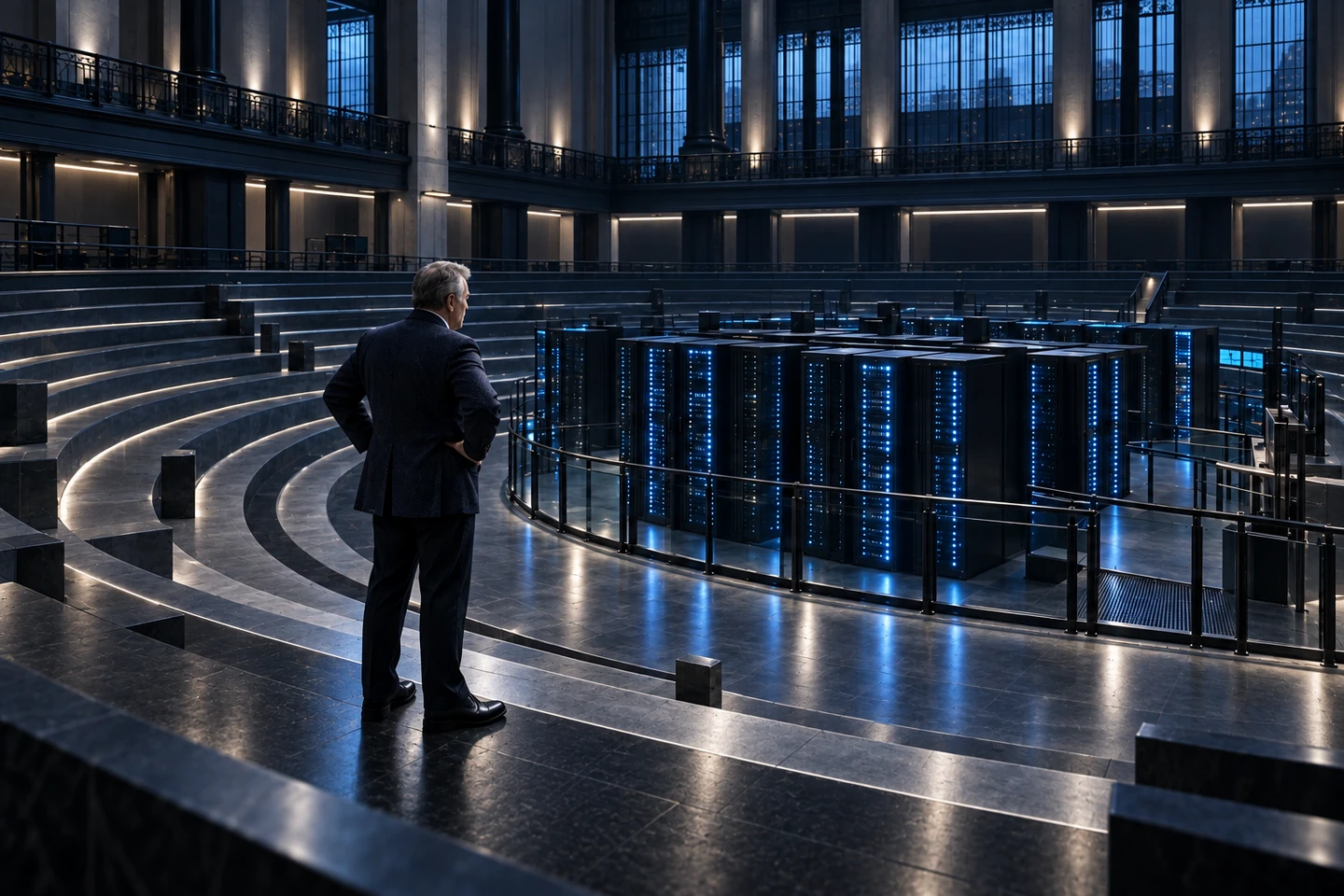
Imagine a trader standing in a crowded trading pit.
People shout prices. Hands fly through the air. He can see who is eager to buy and who is desperate to sell.
Then trading moves onto screens.
The crowd disappears. Orders meet electronically. What once required a person on the floor can happen through software.
For someone whose advantage was being in that pit, this was a serious threat. For the market, it was a change in how trading worked. CME Group closed most of its open-outcry futures pits after floor trading had fallen to only one percent of its futures volume, while trading continued electronically.
Today, the threat has a new name: AI.
Some traders ask, “Will AI replace us?”
Others have already found what sounds like the answer. An advertisement tells them an AI trading bot can make the decisions, place the trades and generate profits while they sleep.
That raises a question I cannot ignore:
If the bot reliably prints money, why is its owner selling it to you?
Will AI Take Over Trading?
Parts of trading have already been automated.
Computers scan markets, route orders and execute strategies at speeds a person cannot match. The SEC has described trading and communication at U.S. securities exchanges as almost entirely automated.
So I would not tell a trader, “Don’t worry. Humans will always do everything better.”
They won’t.
But placing an order is only one part of trading. Someone must still decide which opportunity matters, what risk is acceptable, how a strategy is evaluated and when it no longer works.
A machine can perform some of those jobs too. The question is whether it performs them well enough to make money after costs and losses, across changing market conditions.
That is a much higher bar than producing an impressive chart.
The Trading Bot Sales Pitch
You’ve probably seen some version of it.
A video shows a dashboard full of green numbers.
“AI-powered.”
“Fully automated.”
“Trade while you sleep.”
The person selling it says you don’t need experience. You just need to connect the bot and let it work.
I would slow down right there.
If I owned a machine that could reliably generate large profits with little risk, selling subscriptions might be an odd choice. I could trade my own capital, seek investors or protect the method from competitors.
That question does not prove the seller is a scammer. It does mean the seller owes you a convincing answer.
There are legitimate reasons to sell trading software. A developer might sell a tool that automates your rules. A strategy might produce modest returns that are more valuable as a software business. Its owner might lack the capital to trade it at scale.
But those are very different products from a supposed profit machine.
The CFTC warns that AI cannot guarantee future returns or predict sudden market changes. FINRA has separately warned about misleading AI claims and unregistered auto-trading services.
A Bot Can Execute Rules. Where Did the Rules Come From?
Suppose I build a bot with one instruction:
Buy a stock when its 20-day moving average crosses above its 50-day moving average. Sell when the lines cross back.
The bot can follow that instruction without fear, hesitation or fatigue.
Wonderful.
But what happens when the stock spends two months moving sideways and the lines cross repeatedly?
The bot will continue following its instructions. That could mean one losing trade after another.
The software did its job.
The strategy failed to account for the market it was trading.
Adding “AI” to the label does not settle the problem. The bot still needs a sound way to select trades, manage risk and respond when the conditions behind its past results change.
Automation can remove human hesitation. It can also repeat a bad decision perfectly.
What I Would Ask Before Paying for a Trading Bot
Not “What is its win rate?”
That is easy to advertise and incomplete as evidence.
I would ask:
Where are the live trading records?
Show the results from a real broker account over a meaningful period, including losing months. A backtest shows how rules performed on historical data under certain assumptions. It is not the same as live execution.
What was the worst loss or drawdown?
A bot that made 40% after first losing 60% is a very different product from the headline “40% return.”
Are all costs included?
Spreads, commissions, financing costs and slippage can change the result, especially for a bot that trades often.
What happens when it is wrong?
Does it exit? Stop trading? Reduce exposure? Or keep adding to a losing position?
Why should the edge survive more customers using it?
If many buyers are running similar orders at similar times, the actual fills may differ from the seller’s results.
And finally:
Where does the seller’s dependable income come from—the trading or the subscription fees?
A seller does not have to trade their own strategy to offer useful software. But if they claim the bot is a reliable source of trading income, they should be prepared to show evidence that supports that claim.
How I Think Traders Should Use AI
I would start by giving AI tasks whose output I can check.
Let it scan a large group of stocks against clearly written criteria. Let it organise earnings dates and company filings. Let it calculate position sizes from my risk limits. Let it review my trading journal and show me which setups I repeatedly mishandle.
Those jobs can save time and expose mistakes.
I would be far more cautious about saying, “Here is my account. Decide everything for me.”
If I cannot explain what the system trades, when it stops and how much it can lose, I have handed over the most important parts of my trading without understanding them.
My test for any AI tool is simple:
Does it help me make a decision I can understand, test and manage?
If it only gives me more trades and a more confident story, it may be amplifying my activity rather than my edge.
Will Traders Who Ignore AI Fall Behind?
I think many will.
A trader who spends hours collecting information that software can organise in minutes has less time to work on the decision itself.
But using AI is not a competitive advantage by default. If everyone has access to similar tools, faster scanning alone may not distinguish you.
The opportunity is to build a clearer process: define what you’re looking for, use AI to find and examine it, record the decisions, and test whether the results improve.
That takes more work than buying a bot and going to sleep.
Which is exactly why the sales pitch is so attractive.
Final Thoughts
I don’t think AI will eliminate traders anytime soon. I do think it will replace more of the tasks traders once spent their days doing.
Some people will adapt. Some will lose an advantage they thought would last. The trading pit already showed us that technology can make an old way of working disappear.
But I would not respond by purchasing the first “AI profit bot” I see.
I would ask its seller to prove the live results, show the losses and explain why the method should keep working after it has been sold to strangers.
Automation is real. A profitable edge is much harder to prove.
Let AI help you search, calculate and review.
When someone offers to sell you a machine that supposedly does the earning for you, ask why they are selling it—and don’t let the answer be another screenshot of green numbers.