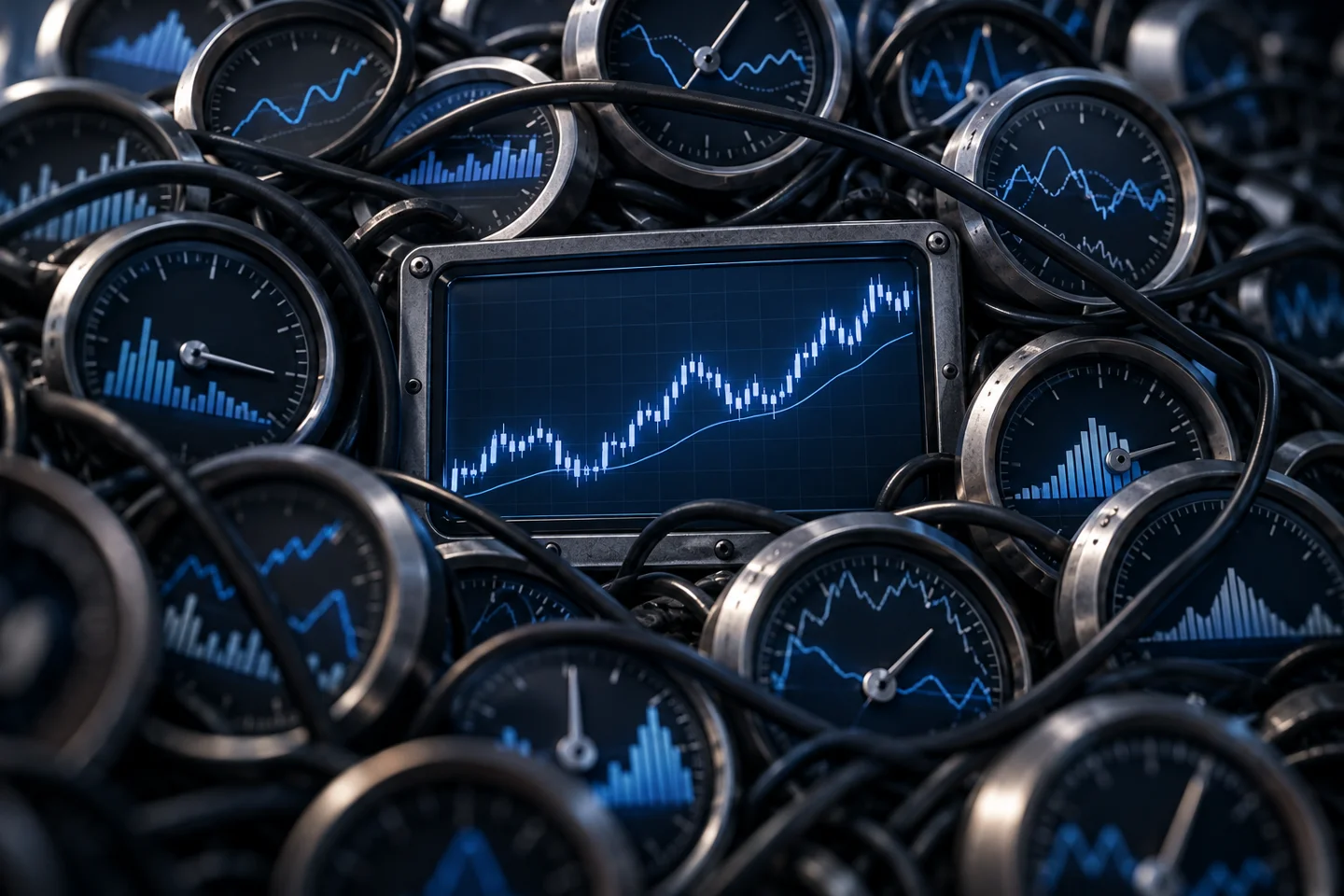
If you have ever looked at another trader’s chart, you have probably seen something like this.
RSI. MACD. Fibonacci retracements. Moving averages. Volume Profile. Bollinger Bands. VWAP. Support and resistance.
Before long, the chart becomes so crowded you can barely see the price itself.
The strange part?
Many traders believe adding another indicator will improve their results.
In reality, it often does the opposite.
More Information Doesn’t Always Mean Better Decisions
Imagine you are trying to cross a busy road.
One person gives you directions.
Easy.
Now imagine ten people start shouting at the same time.
“Go now.” “Wait.” “Watch the car.” “Run.” “Turn back.”
Suddenly, more information does not make the decision easier.
It makes it harder.
Trading works exactly the same way.
Every Indicator Tells A Different Story
Here is something many traders do not realize.
It is completely possible for one indicator to tell you to buy while another tells you to sell.
RSI might say the stock is overbought.
A moving average might still be pointing higher.
MACD could remain bullish.
Volume could be weakening.
Who is right?
Maybe all of them. Maybe none of them.
Because indicators do not predict the future. They simply measure different aspects of the market.
The problem begins when traders expect them to agree all the time.
The Trap Most Traders Fall Into
I once knew a trader whose charts looked like an aircraft cockpit.
Every trade required another confirmation.
Another indicator. Another opinion. Another piece of news.
Then something interesting happened.
Whenever a trade lost money, there was always a new explanation.
“I should have looked at RSI.”
“I ignored Fibonacci.”
“The news changed everything.”
“It was because of the Fed.”
Every losing trade had a different excuse.
But the real problem was not the indicators.
The real problem was he never gave one strategy enough time to prove whether it actually had an edge.
Every Strategy Has Losing Trades
This is one of the hardest lessons in trading.
Even great strategies lose.
Even professional traders lose.
Even the best hedge funds lose.
A losing trade does not automatically mean your strategy is broken.
It simply means probability did not work in your favor that time.
If you change your strategy after every loss, you will never know whether it actually worked.
The Market Doesn’t Reward Complexity
Many people assume professional traders use dozens of indicators.
In reality, many successful traders have surprisingly simple processes.
Not because indicators are useless.
But because they have already decided what matters most.
The goal is not to collect more signals.
It is to follow one repeatable process with discipline.
The Real Question Isn’t “Which Indicator Is Best?”
It is this:
Does your strategy have a proven edge over many trades?
Because that is how probabilities work.
One trade proves nothing.
Ten trades prove very little.
But after dozens or even hundreds of trades, patterns begin to emerge.
That is where confidence comes from.
Not from adding another indicator.
Simplicity Beats Certainty
Many traders are not searching for better indicators.
They are searching for certainty.
The problem is the market never offers certainty.
Only probabilities.
Adding more indicators does not eliminate uncertainty.
Sometimes it simply creates more reasons to hesitate.
The Best Traders Think Differently
Instead of asking:
“Which indicator should I add?”
They ask:
“Is my process consistent?”
Did I follow my rules?
Was the risk acceptable?
Did I execute the strategy correctly?
Because over time, consistency usually beats complexity.
Final Thoughts
The market does not care whether you use one indicator or twenty.
It does not reward traders for having the busiest charts.
It rewards traders who follow a repeatable strategy with discipline.
Every strategy will have losing trades.
That is part of trading.
The goal is not to avoid every loss.
The goal is to stick with a strategy that has an edge long enough for that edge to play out.
At Zenith, that is exactly how we think.
Not by asking whether one more indicator agrees.
But by asking a much more useful question:
Does today’s evidence justify committing capital?
Because successful trading is not about finding more signals.
It is about making better decisions consistently.