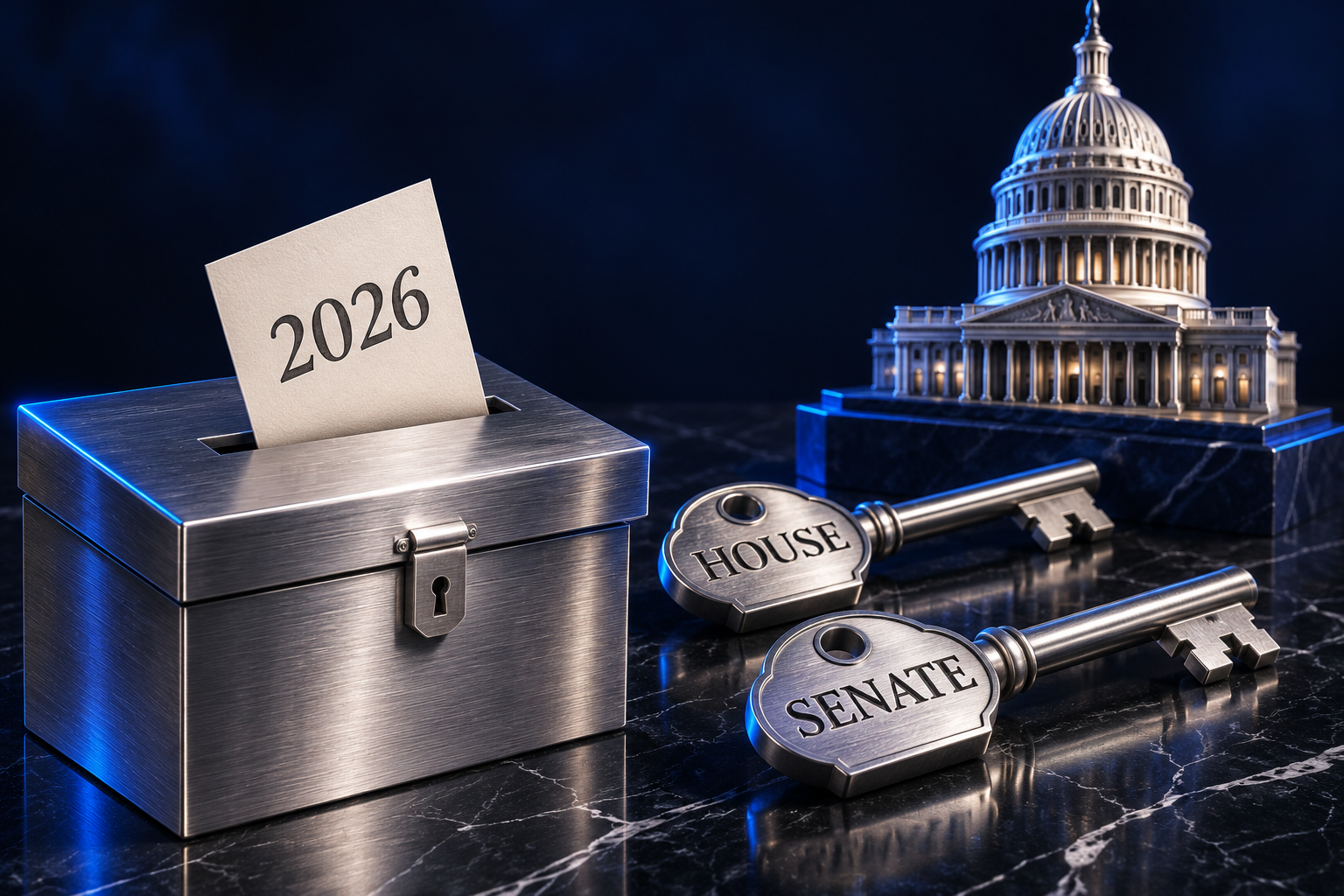
Your preferred party can win an election while your stocks lose money.
That is an awkward possibility if your investment strategy consists of watching the results and buying whichever sector the television presenter calls a winner.
The US midterms matter because they can change what government can approve, fund and block. But turning an election result into a useful investment decision requires several more steps.
Imagine your apartment building elects a new management committee.
One candidate promises lower maintenance fees. Another wants new lifts, better security and charging points for electric cars.
A resident hears “new committee” and immediately pays more for an apartment.
“Property values are going up,” he says.
Perhaps. But has anyone checked the reserve fund? Who approves the work? Will owners face a special payment? And did the seller already raise the asking price because everyone expected the improvements?
The election changes who helps make decisions. The building still has a budget.
Stocks deserve the same attention to what happens after the announcement.
What Americans are actually choosing
The 2026 US general election takes place on November 3. This article is a pre-election explanation, prepared before Election Day polling begins, rather than an assessment of results. The presidency is not on this ballot. Voters are choosing all 435 House seats and 35 Senate seats, alongside state and local offices. USAGov and the official election bulletin explain the congressional elections.
That can change control of one or both chambers of Congress. It does not instantly replace the government or rewrite the tax code.
New congressional terms begin at noon on January 3, 2027. Until then, the existing Congress remains in place. The constitutional start of a term should also not be confused with the date Congress first meets. US Constitution
For investors, there are therefore two clocks: when expectations change and when policy can actually change.
A stock can respond to the first long before the second produces any revenue.
A majority has power but also limits
Congress matters because it makes laws and controls federal taxing and spending decisions. The House and Senate must generally agree on legislation, which then goes to the president. Overriding a presidential veto requires two-thirds of those voting in each chamber, with a quorum present.
Revenue bills originate in the House, but the Senate can amend them. Winning the House alone does not give a party a button marked “Change corporate taxes.” US Constitution
The Senate adds another complication. Ending debate on most contested legislation normally requires 60 votes when all seats are filled. That is a procedural hurdle, not a rule that every bill needs 60 votes to pass. Certain budget legislation can use reconciliation, subject to restrictions. Senate procedure and the Congressional Research Service explain the distinction.
Why include this in an investing article?
Because the distance between a campaign promise and a company’s bank account is often where the investment thesis breaks.
Before asking which stocks benefit, ask what the winning politicians can actually get approved.
Follow the money into the business
The first route is after-tax earnings.
Here is a deliberately simplified example, using hypothetical rates rather than current law or a campaign proposal.
A company earns $100 before tax. At a 20% tax rate, it keeps $80. At 25%, it keeps $75. That is a 6.25% reduction in after-tax profit, assuming everything else stays unchanged.
The five-percentage-point tax increase is not a 5% decline in profit. The base matters.
Even then, a real company may have overseas earnings, deductions, tax credits or losses that make its effective rate different. Start with its filings rather than applying the headline rate to every stock.
The second route is demand supported by government spending.
A supplier may benefit if funded projects become orders. But an election promise, a proposed budget, enacted funding and recognised revenue are different stages. Ask how much of the company’s business depends on the programme, how contracts are awarded and whether the company has capacity to deliver.
The third route is cost and competition.
Changes to regulation, subsidies or enforcement priorities may alter costs, barriers to entry and customer behaviour. The effects can run in opposite directions. Easier entry could help a small challenger while weakening an established company’s protection.
A friendly industry headline is only the beginning of the analysis.
The second effect can undo the first
Suppose investors expect a policy package to support corporate earnings.
That sounds positive. But if the same package also raises expectations for government borrowing or inflation, investors might demand higher bond yields. Higher required returns can reduce what they are willing to pay for future company profits.
This is a possible mechanism, not a forecast that a particular election result must push yields higher.
Even a spending headline needs translation. Imagine a hypothetical $100 million programme. A supplier wins 10% of it, producing $10 million of revenue. At an 8% operating margin, that is $800,000 of operating profit before interest and tax, assuming it can deliver at that margin.
The programme’s size is not the supplier’s profit. Payment timing and upfront working capital matter too. A company may need to pay workers before the government pays its invoice.
These numbers are illustrative. They show why a large policy announcement can produce a much smaller benefit for shareholders.
Congress also does not vote on the Fed’s next interest-rate decision. The Fed says its monetary-policy decisions do not require congressional or presidential approval. Federal Reserve
Political influence, fiscal consequences and central-bank decisions interact. They are not the same thing.
Three outcomes to think through
One party controls the presidency and both chambers. More of its legislative agenda may become feasible. But narrow margins, internal disagreements, Senate procedures and competing priorities still matter. The useful question is which specific proposals have a credible route to passage.
Control is divided. Major new legislation may become harder to pass. Investors who dislike policy uncertainty might welcome limits on change. Yet companies depending on new funding or incentives may see delays instead. Disagreement over essential spending can also create uncertainty. “Gridlock is bullish” leaves out too much.
The outcome is close or unresolved. Investors may revise expectations as votes are counted and control becomes clearer. A first headline can be less useful than the eventual seat arithmetic. Avoid turning incomplete information into an irreversible decision.
These are scenarios, not predictions of the 2026 result or market direction.
They also explain why simply sorting stocks into Republican winners and Democratic winners is inadequate. A business has customers, costs, competitors and a price. Its party label is not on the income statement.
What about the famous post-midterm rally
There is a historical pattern worth understanding without worshipping it.
Schwab’s research reports that S&P 500 price returns were positive in the six months following each of the 13 midterms from 1974 through 2022, averaging 12.4%. Its three-month window was positive in 11 of those 13 cases. These are price returns, not returns including reinvested dividends. Schwab’s historical analysis
Interesting? Yes. A guarantee for the next election? No.
Thirteen observations are a small sample. Change the period, starting point or measurement window and you are asking a different question. More importantly, elections took place alongside changing inflation, monetary policy, earnings and economic conditions.
The pattern does not isolate what the election itself caused.
A positive six-month endpoint also says nothing about how uncomfortable the journey was. Someone using too much leverage can be forced out before the eventual recovery appears on a historical chart.
A market pattern can describe the past accurately and still be a poor instruction for your next trade.
The sensible use of this history is to challenge blanket pessimism, not to replace business analysis or risk management.
A practical way to read the result
Start with a company you already understand rather than a list of supposed election winners.
Write down the policy it is exposed to. Be specific: a tax credit, a procurement programme, an approval process or a proposed change in competition. “Politics will help” is not specific enough.
Then trace the chain from result to legislation, implementation and cash flow. Identify the point where your reasoning could fail. Perhaps the required votes are missing. Perhaps the benefit reaches customers rather than shareholders. Perhaps competitors capture most of the extra demand.
Next, separate the business effect from the price already paid. A favourable outcome can disappoint if investors expected an even bigger benefit. You cannot measure expectations perfectly, but you can compare valuations, management guidance and the assumptions needed to justify them.
Finally, decide what evidence would change your view. For an investor, that may be enacted policy and updated earnings estimates. For a trader, it also requires a qualifying price setup, an invalidation level and manageable exposure. An election thesis cannot supply those automatically.
If several holdings depend on the same policy, count that as shared exposure. Five tickers are not five independent ideas when all five need the same bill to pass.
Back at the apartment building
The new committee wins. Residents celebrate. Someone orders refreshments before anyone checks the accounts.
Our buyer still has a useful question to ask: “Which improvements can actually be funded, and how much am I already paying for them?”
That question does not require him to dislike the new committee. It requires him to think like an owner.
The midterms can change the people holding the keys. Your investment depends on what those keys can open, what it costs and the price you paid before the door moved.