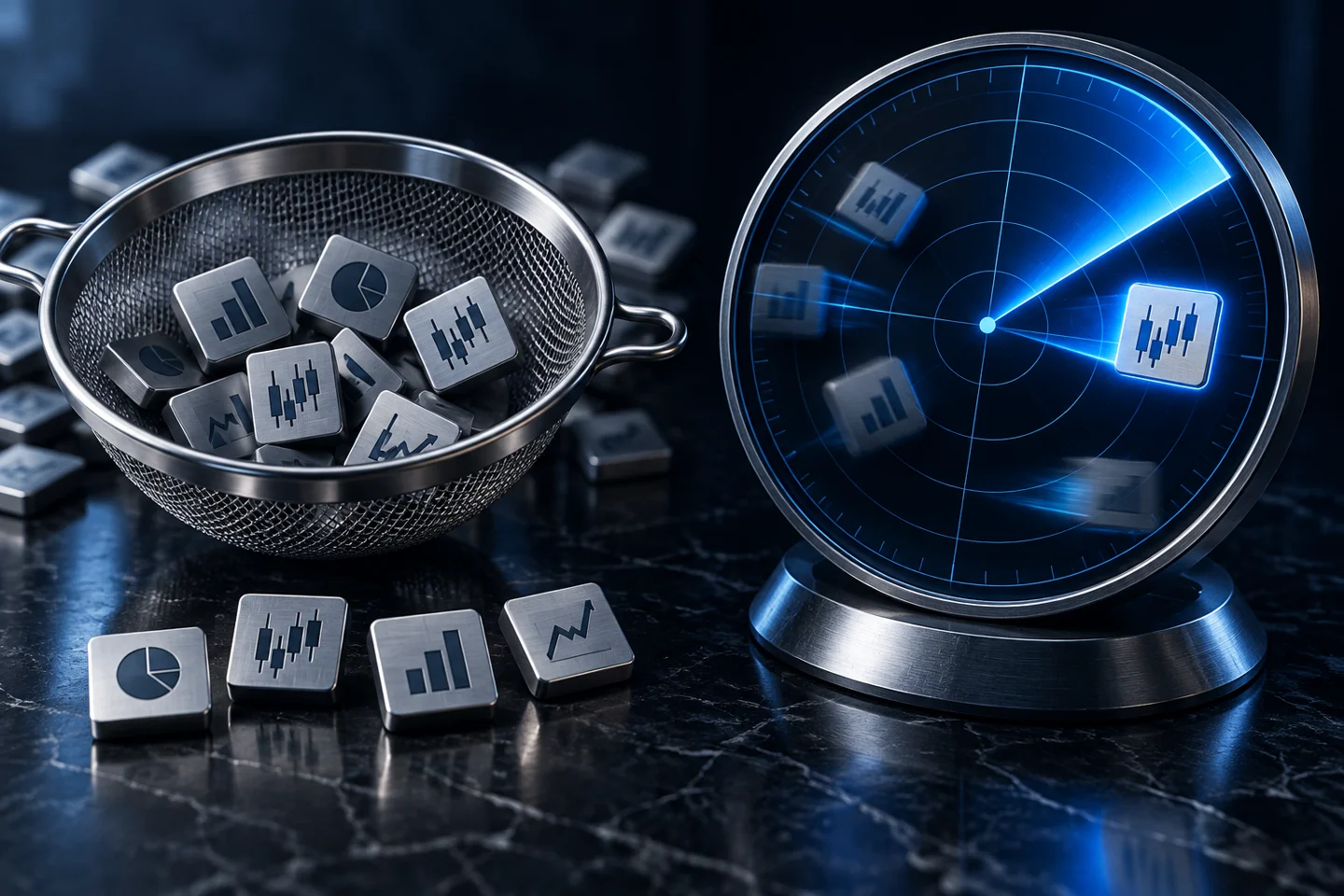
If you’ve searched for trading tools, you’ve probably come across both stock screeners and stock scanners.
Many people assume they’re the same thing.
They’re not.
Understanding the difference can save you time—and help you avoid relying on the wrong tool.
But there’s an even bigger question most traders never ask.
What happens after a screener or scanner finds a stock?
That’s where most trading mistakes begin.
What Is a Stock Screener?
A stock screener filters stocks based on criteria you choose.
For example, you might screen for:
- Companies with a market capitalization above $10 billion
- Stocks trading above their 200-day moving average
- Revenue growth above 20%
- Price-to-earnings ratio below 25
- Dividend yield above 3%
A screener works on static filters.
It searches the market and returns stocks that match your conditions.
If you want to build a watchlist or narrow thousands of stocks down to a manageable number, a stock screener is useful.
Popular stock screeners include TradingView, Finviz, and Stock Rover.
What Is a Stock Scanner?
A stock scanner continuously watches the market for new activity.
Instead of filtering once, it monitors prices in real time and alerts you when something changes.
A scanner might notify you when:
- A stock breaks above resistance
- Volume suddenly spikes
- A new 52-week high is made
- An earnings gap appears
- Momentum accelerates
Scanners are designed for speed.
Many active traders use them throughout the trading day to discover opportunities as they develop.
Stock Screener vs Stock Scanner
Here’s the simplest way to think about it.
Both tools help you find stocks.
Neither tells you what to do next.
The Problem Most Traders Run Into
Imagine your screener returns 75 stocks.
Now what?
Which one deserves your attention?
Should you buy it today?
Wait for confirmation?
Ignore it completely?
This is the gap many traders don’t realize exists.
Finding opportunities isn’t usually the difficult part.
Making good decisions is.
Why Finding Stocks Isn’t Enough
Every day, thousands of stocks satisfy someone’s screening rules.
Some go on to become excellent trades.
Others fail almost immediately.
A scanner can’t tell you whether momentum is healthy.
A screener can’t tell you whether market conditions support the trade.
Neither evaluates whether structure, momentum, and broader market conditions align before capital is committed.
That’s why two traders can use the exact same screener and end up with completely different results.
A Better Question to Ask
Instead of asking:
Which stock screener should I use?
Ask:
How do I decide whether a stock is actually worth buying after I find it?
That’s a much more valuable question.
Because your returns aren’t determined by how many stocks you find.
They’re determined by which ones you choose to trade.
How Zenith Approaches It Differently
Zenith isn’t another stock screener.
It isn’t another stock scanner either.
Zenith assumes you’ve already found the stock.
The next step is answering the decision that actually matters.
Buy.
Wait.
Stay Out.
Every stock is evaluated using the same structured framework:
- Bias — Is the longer-term direction supportive?
- Structure — Is price behaving constructively?
- Momentum — Is participation strengthening or weakening?
- Market State — Is the broader environment favorable?
Instead of producing another list of tickers, Zenith helps answer whether a stock deserves your capital before you place the trade.
Which Is Better?
The answer depends on what problem you’re trying to solve.
If you need to find stocks, use a stock screener.
If you need to monitor stocks, use a stock scanner.
If you need to decide whether a stock is actually worth buying, neither is enough on its own.
That’s the gap Zenith is designed to fill.
Final Thoughts
Stock screeners and stock scanners are valuable tools.
They help you discover opportunities.
But discovering a stock isn’t the same as knowing whether it’s worth risking your capital.
That’s where better decision-making matters.
If you’ve already found a stock you’re considering, use Zenith to check it through a consistent framework before making your next move.
Check any US stock free and get a structured Buy, Wait, or Stay Out decision in seconds.