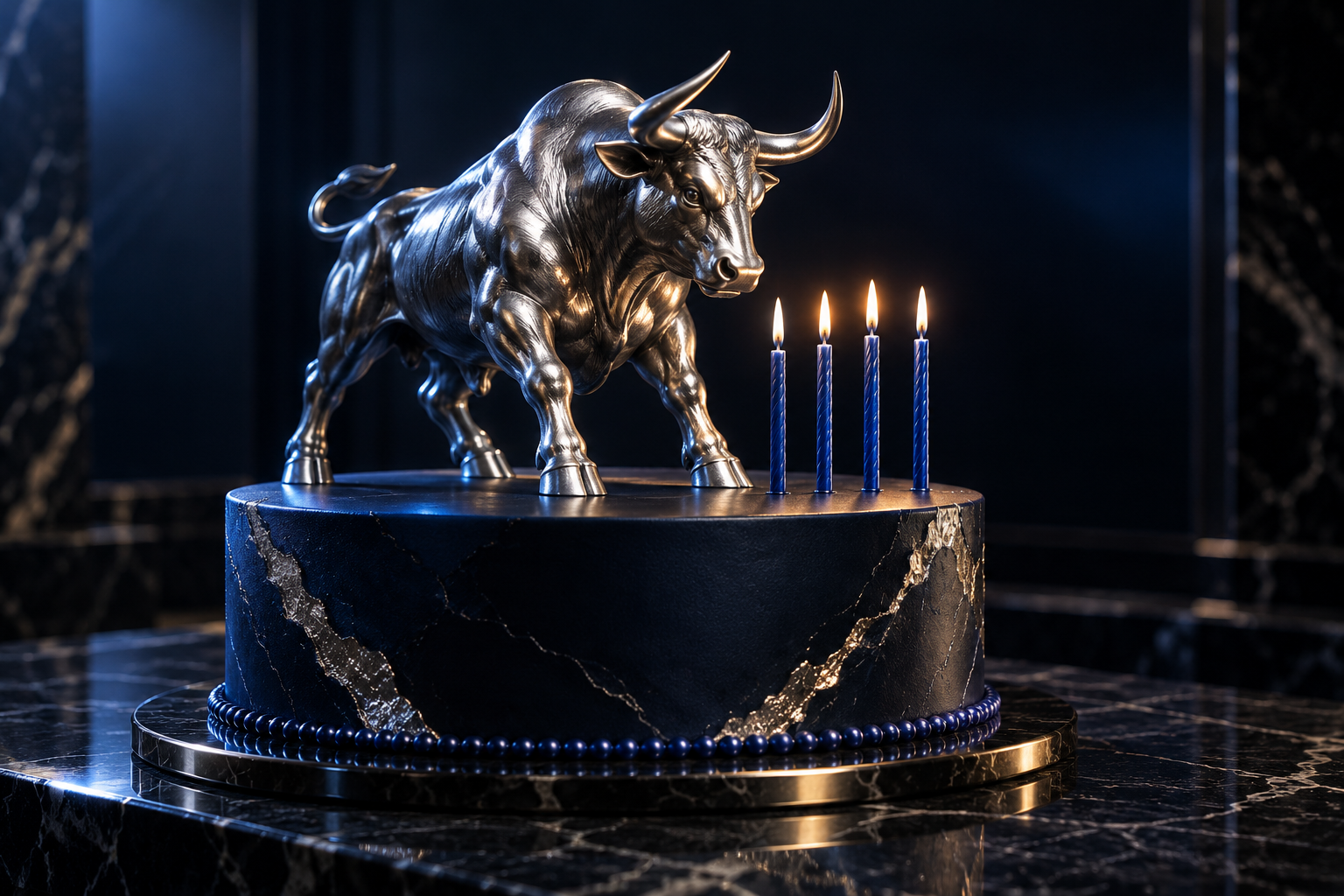
Imagine going to a friend's birthday dinner.
Someone looks at the cake and says, “Forty already? Better stop exercising. Too old.”
Another person says, “He made it to forty. Confirm can live another forty.”
You would probably ask both of them to put down their drinks.
Yet this is how we sometimes talk about the stock market.
The S&P 500 bull market turned four on October 12, 2026, counting from its October 12, 2022 closing low.
Immediately, two familiar opinions appear.
“Four years already. A crash must be coming.”
“Four strong years. This market cannot lose.”
Same birthday. Two very different stories. Neither tells us what happens next.
THE CANDLES DON'T TELL THE WHOLE STORY
By its fourth birthday, the S&P 500 had gained about 118% from that closing low, excluding dividends, according to LPL Research.
That sounds like a comfortable journey when you squeeze it into one sentence.
It wasn't.
In April 2025, the index came close to a 20% decline on closing prices. It briefly crossed that threshold intraday, but never closed there, which is why this closing-price bull-market clock continued.
Four years of progress did not mean four years without pain.
And nobody standing at the October 2022 low received an invitation saying, “Congratulations. The next bull market starts here.”
The birthday became obvious afterwards.
That matters, because looking backwards makes uncertainty disappear. A chart shows you where the market went. It doesn't show you how difficult the next decision felt before it happened.
AGE IS A REASON TO CHECK, NOT A REASON TO GUESS
Back to the birthday dinner.
If you wanted to understand your friend's health, would you count the candles or look at his condition?
The same question helps with markets.
Instead of asking, “Is this bull market too old?”, ask what the market is actually doing.
Are pullbacks holding important support? Are prices still making higher highs and higher lows? Is strength spreading across more stocks, or are a few large names doing most of the work?
These observations can help you assess conditions. They still cannot promise tomorrow's direction.
A birthday is background information. It isn't a buy or sell button.
WHAT THIS MEANS FOR YOUR NEXT TRADE
A healthy market can still give you an unhealthy entry.
Imagine a stock has already jumped sharply. You buy because everyone is celebrating. Your sensible stop is far below, while the next area of resistance is just above.
The market's birthday hasn't improved that trade. You're still risking too much for too little potential reward.
The opposite mistake is shorting a strong stock simply because the rally “has lasted long enough.”
The market doesn't owe you a reversal because you've run out of patience.
Before entering, answer three questions:
1. What must price do to confirm my idea? 2. What would show that my idea is wrong? 3. Is the realistic reward worth the risk, including trading costs?
If those answers aren't clear, another candle on the cake won't help.
Being positive about the market doesn't require buying everything. Being cautious doesn't require betting against everything either.
You can respect the trend and still be selective.
HAPPY BIRTHDAY. NOW CHECK THE PLAN.
Four years is worth acknowledging. It tells us how far this market has travelled.
It doesn't tell us how far it has left to go.
So enjoy the birthday. Cut the cake. Take a photo.
Just don't ask the candles where to put your money.