“AI is stealing our jobs.”
It writes. Designs. Codes. Analyses information.
Now it can study financial reports and help build trading strategies.
So the question becomes personal:
If AI can do all that, what happens to the human trader?
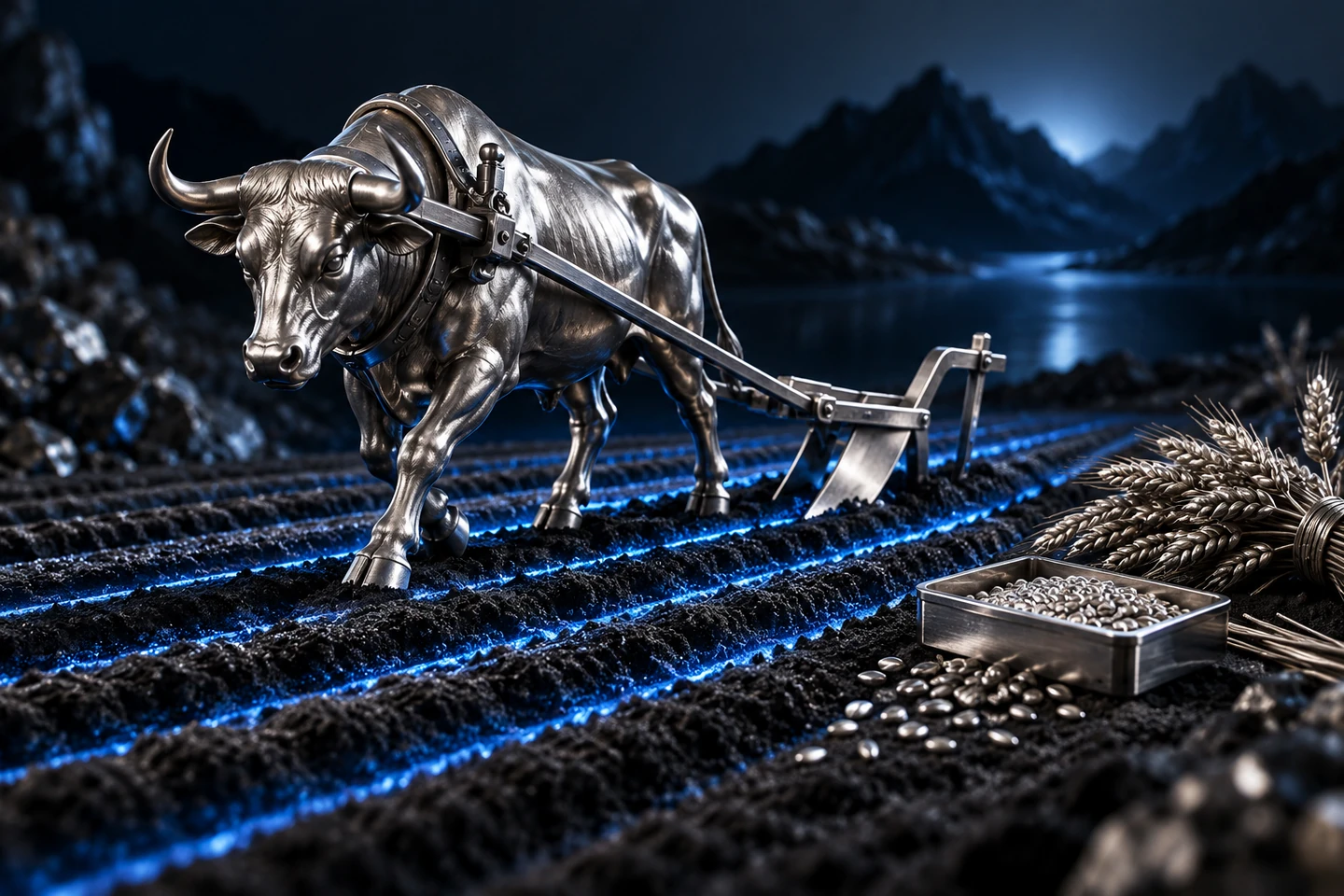
Imagine a farmer watching his neighbour attach a plough to an ox.
The animal pulls through the soil faster than he could manage by hand.
He can complain that the ox is taking his work.
Or he can ask:
“How much more could I grow if I learned to use one?”
That is how I think traders should approach AI.
Use it to increase what you can accomplish. Then learn which decisions still deserve your attention.
The Farmer’s Job Was to Grow Crops
Pulling a plough was hard work.
But the farmer’s purpose was to produce a harvest.
The ox took over some of the physical effort. The farmer still had to choose the crop, understand the land and decide when to plant.
Trading has its own version of pulling the plough.
Scrolling through hundreds of charts.
Copying trades into a journal.
Reading earnings reports to find a particular number.
Calculating position sizes.
Those tasks may be necessary. But spending hours on them does not automatically make you a better trader.
Your purpose is to identify opportunities, make sound decisions and manage the risk.
If AI helps you complete the preparation faster, that can leave more time for the work that determines your results.
We Have Seen Trading Change Before
Markets once depended heavily on people standing in trading pits.
Electronic trading changed that. Algorithms and high-frequency trading changed it further.
Some roles disappeared. Others evolved. Human traders continued to operate, although the tools, competition and skills required changed.
That history does not prove human traders will always have a place.
It does challenge the assumption that a new technology automatically ends all human participation.
The more useful question is:
“Which parts of my trading process can technology improve—and where does it make the competition harder?”
If your advantage depends on reacting to public information faster than automated systems, you should question that advantage.
If your process involves selecting swing setups, planning scenarios and managing exposure over days or weeks, AI may help with parts of the workflow.
Whether that produces an edge still needs evidence.
AI Can Help You Prepare. Preparation Is Not Profit.
Imagine two traders using AI.
The first asks:
“What stock will rise tomorrow?”
The AI produces a confident answer.
He buys.
The second asks:
“Review my last 100 trades. Separate them by setup, calculate the results after costs, and show where I broke my own rules.”
She checks the calculations against her records.
She discovers that one setup performs poorly when she enters far above its planned entry. Another looks promising until trading costs are included.
Same technology.
Different use.
The first trader received a prediction.
The second gained information that could improve a decision.
A useful trading assistant should help you understand your process—not simply give you another confident opinion.
Where AI Can Help a Trader
Think of the tasks you repeat every week.
An AI tool, given suitable data, could help organise your journal, compare setups, summarise company announcements or draft scenarios before a trade.
For example:
“If this stock holds above the breakout area, what conditions would support my continuation setup? If it falls back into the range, what would invalidate that idea?”
You still need clear strategy rules and accurate market data. AI cannot repair a vague plan merely by describing it elegantly.
Its answers also need checking. It can use outdated information, make calculation errors or invent details.
Think of a junior assistant who works quickly.
Useful? Potentially.
Someone you would give unrestricted control of your trading account because they sound intelligent?
I wouldn’t.
The Biggest Danger: Faster Bad Decisions
An ox can help a farmer plough more land.
But if he plants the wrong crop in unsuitable soil, working faster does not solve the problem.
AI can create the same trap in trading.
It can help you analyse ten stocks instead of one. It can produce twenty strategy variations. It can give a polished explanation for almost any position.
But perhaps your problem was never a shortage of ideas.
Perhaps you enter too early.
Perhaps your positions are too large.
Perhaps you keep changing strategies after a loss.
AI may simply help you repeat those mistakes faster.
Before adding it to your workflow, ask:
“What specific problem am I trying to solve?”
A shorter research process is measurable.
A more accurate journal is measurable.
Fewer position-sizing errors are measurable.
“AI will make me profitable” is a hope.
Will AI Trading Bots Replace Us?
Some automated strategies are legitimate. Automation can execute defined rules consistently and at speeds humans cannot match.
But buying a trading bot is not the same as buying an edge.
A strategy that looks excellent in a historical test may fail with new market conditions, realistic trading costs or live execution.
And the fact that someone sells a bot does not prove it is a scam. Selling software can be a legitimate business. Equally, the sales page’s claims do not prove it works.
I would ask for evidence:
What are the rules? How was performance measured? What losses occurred? Do the results include costs? Does live performance resemble the backtest?
Automation can repeat a strategy. It cannot make a weak strategy strong merely by repeating it perfectly.
My Take: Learn to Use AI Without Handing It Your Judgment
Research outside trading offers evidence that AI can improve productivity. One customer-support study found an average improvement of roughly 14% in issues resolved per hour. That result is specific to its setting; it does not establish that AI makes traders more profitable. NBER: Generative AI at Work
For trading, the evidence has to come from your own process.
Start with one task.
Use AI to help complete it.
Check the output.
Measure whether the change saves time, reduces errors or improves a decision.
Then keep what helps.
You do not need to become an AI engineer. You need to understand your trading well enough to know what you are asking the tool to do—and recognise when its answer is wrong.
Final Thoughts
AI will change trading. It may replace some tasks, reshape some roles and make certain forms of competition tougher.
But treating it only as a thief misses the opportunity to put it to work.
The farmer who used an ox did not stop being a farmer.
He changed how he produced his harvest.
A trader can do the same: use AI to improve preparation, study results and reduce repetitive work.
Then judge it by the outcome.
Let AI help you do more work. Make sure that work leads to better trades.