"The chips are fine," a trader said on Thursday, watching his screen turn red. "It's the electricity bill that scares me."
The chips were not fine. The Nasdaq fell 5.52% that day. But the trader had the right fear. Chips fall once. A power bill comes every month.
Mei would have understood in one minute. She runs a kopitiam in a shophouse with three other stalls. The four share one electricity meter. Last month a new tenant moved in upstairs and filled a room with freezers that run all day and all night. The shared bill went from $800 a month to $1,400.
Mei did not buy a freezer. She did not use more power. Her share still went up.
"Mr. Tan," she said to her landlord, holding the bill in both hands, "I sell kopi. I did not ask for a cold room."
"Then ask the cold room to pay for its own meter," Mr. Tan said.
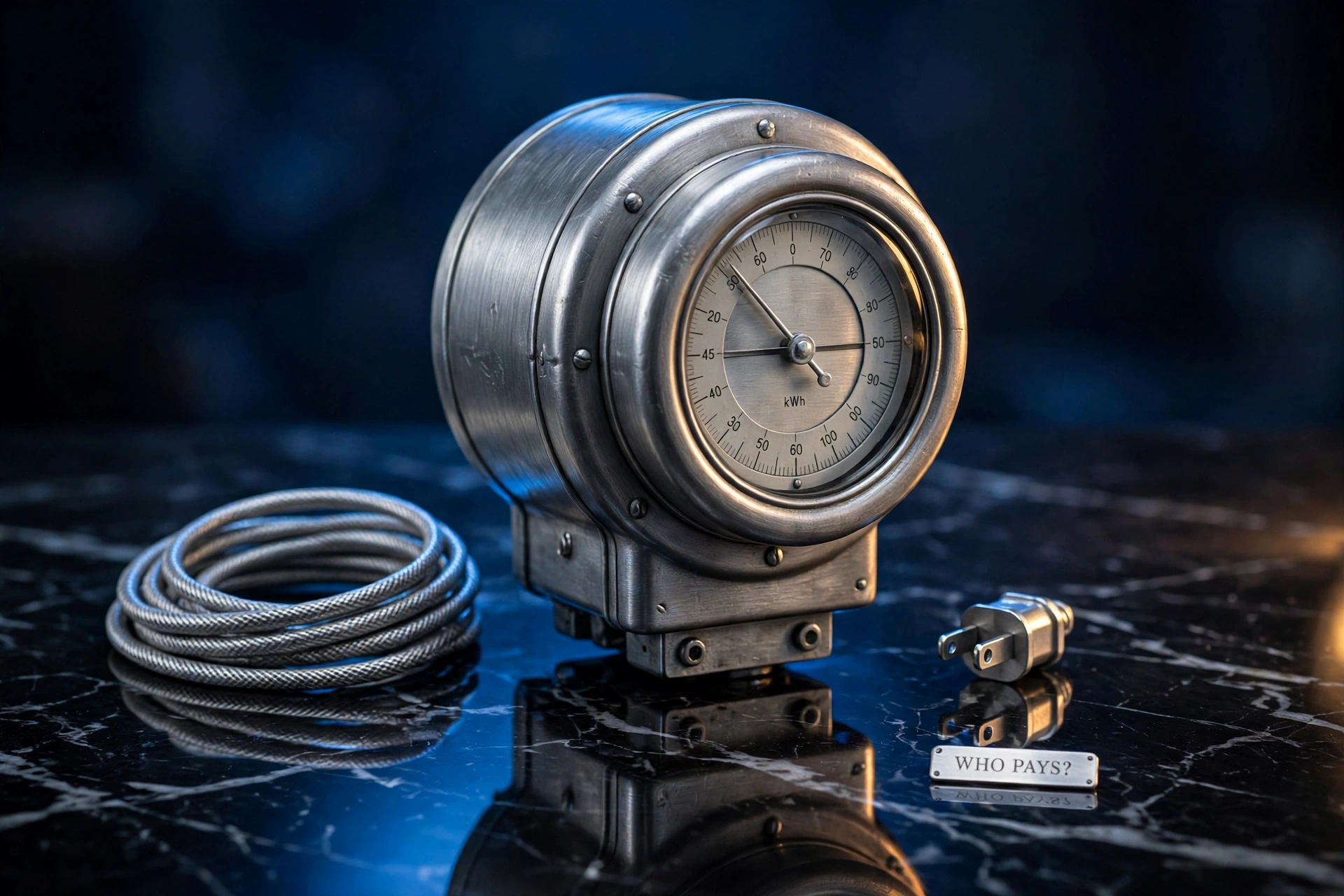
That is the whole debate, in one shophouse. The AI buildout is the cold room upstairs. The grid is the shared meter.
The bill has already arrived. It just has no name on it yet.
Nobody announced a new charge on Thursday. Two senators announced a new argument.
Senator Chuck Schumer said on 5 November that protecting consumers from higher energy costs linked to data-centre expansion would be among his priorities next year. Senator Martin Heinrich released a fact sheet the same day, describing legislation that would make large data centres bear the grid costs they create.
Neither man sent anyone a bill. Both said the bill has an owner, and it is not the household next door.
The bill is already being paid, quietly, by everyone on the same grid. Research by economists at the Federal Reserve Bank of Dallas found that data-centre demand raised wholesale electricity prices in the Arizona–New Mexico region by an estimated 8.6%, or $2.93 per megawatt-hour, during 2024 and 2025, and projects 14.7%, or $4.32 per megawatt-hour, by 2028.
That is a regional estimate from a working paper, not a national figure or an official Federal Reserve position. But the direction is plain: when a very large customer plugs in, power prices move for everyone on the same grid.
The customer is large. The four biggest spenders — Amazon, Alphabet, Microsoft and Meta — are guiding to roughly $720 billion to $740 billion of capital spending in 2026. That is the buildout, priced in one number.
The spending is not the problem. The cash is.
As a group, the biggest spenders are now burning cash to build. S&P Global Ratings expects all six of the largest hyperscalers to generate negative free operating cash flow in 2026 and 2027, with recovery not until 2029.
A company can spend its way through a bad quarter. It cannot spend its way through a bad decade. The question is whether the cash comes back fast enough to pay for the next build.
One risk is three bills, and they do not come due together
Traders keep talking about "the power risk" as if it were one thing. It is three things, and they do not move together.
The first bill is cost. Heinrich's bill would require new data centres of at least 20 megawatts to cover the incremental grid costs they create, plus their share of the existing grid. In Texas, a new 100-megawatt grid connection request already requires $5 million of financial security — $50,000 per megawatt, paid up front. A cost once shared, waived or deferred becomes a line item on the project's own books.
The second bill is time. A data centre is a building. Power is a permit. The two move at different speeds.
The median new power plant built in the United States in 2025 took about 61 months — five years — from interconnection request to operation, against 22 months in 2008, per Lawrence Berkeley National Laboratory figures. A building that waits five years for power is not a building. It is a reservation.
The pipeline is already shrinking. MSCI Research counted at least 75 US data-centre projects delayed or cancelled in the first quarter of 2026 alone, matching the total for the whole of 2025. Data Center Watch counted the same 75 projects, worth about $130 billion.
The third bill is cash return, the least visible of the three. A chip company sells a chip once and books the revenue. A hyperscaler buys the chip, builds the building, pays for the power, then has to earn it back over years of renting out computing. If the building costs more and takes longer, the return comes later and smaller, and the next round of spending gets harder to justify.
Cost, time, cash. Three bills, three clocks. Watch all three, or you are watching none of them.
A promise is not a law, and a pause is not a ban
Most commentary treats a speech as a statute.
Schumer spoke on 5 November, setting out priorities for a Congress that takes office in January 2027. His words were a priority, not a bill. Heinrich's fact sheet described legislation that already exists — the Bipartisan American Affordability and Jobs Act (S. 5653), introduced on 30 September 2026 and sponsored by Heinrich, Whitehouse, Lee and Capito. It would speed up federal approval of power plants and transmission lines, and force data centres to pay their grid costs. It has not passed either chamber. The Senate is expected to take a procedural vote on Monday, 9 November.
A procedural vote is a step, not a law.
Texas shows the same argument at state level: Governor Greg Abbott told regulators on 21 September to issue no data-centre permits until ERCOT had audited about 300 proposed projects. That audit is due on 10 December. Gina Hinojosa, who defeated Abbott on 3 November and takes office on 19 January 2027, promised a broader moratorium — but it cannot start before she takes office. Texas holds 27% of planned American data-centre capacity, by Wells Fargo's count.
Nothing has been cancelled by a governor-elect's promise. The calendar now has dates on it: 9 November, 10 December, 19 January.
"Protecting consumers from higher energy costs linked to the rapid expansion of data centres will be among my priorities next year." > > — Senator Chuck Schumer, 5 November 2026
A priority is not a price. Trade the direction, not the headline.
Friday was a bounce. A bounce is not a recovery.
Friday gave back only part of Thursday's fall. The Nasdaq rose 1.09% and the S&P 500 rose 0.31% on 6 November, while the Dow fell 0.46%. For the week, the S&P 500 fell 2.7% and the Nasdaq fell 3.4%.
A one-day bounce after a 5.52% fall is not a recovery. It is a pause in a story that has not finished. The story is not about the chips. It is about the bill behind them.
Do the maths on Mei's bill first
Before you believe the next headline, do the maths on a bill you can hold in your hands. Consider a hypothetical — Mei's kopitiam, with the numbers as stated above.
The shared bill is $1,400 a month. Four stalls share it. Split equally, each stall pays $350.
Before the cold room moved in, the bill was $800. Each stall paid $200.
Mei's share is up $150 a month. Her kopi sales have not changed. Over a year, that is $1,800 — for power she never used.
This calculation excludes the cost of installing a separate meter, the rent, the wages, and the price of the kopi itself. It assumes the four stalls keep splitting the bill equally, with no second chance and no discount.
And here is the counter-case: if the cold room adds more freezers, the bill rises again and the equal split breaks. If the cold room closes, the bill falls — but the meter stays shared, so the next tenant starts the same argument again.
A separate meter costs money up front. That is the point. Paying once for your own meter beats paying every month for someone else's freezers.
The same maths scales to a data centre. The numbers get bigger. The argument does not change.
Five questions before you believe the next headline
If you cannot answer these from evidence, the story has not earned its place yet. Has a new cost been written into a law, or only into a speech? Has a project actually been delayed, or only warned about? Is the cash coming back, or is only the spending going up? What date is next on the calendar — and what would change your mind on that date? And if the bill keeps growing, who pays: the builder, the customer, or the household next door?
Demand never paid a bill. Cash did.
Mei is still waiting. She asked Mr. Tan for a separate meter for the cold room upstairs. He said he would think about it. The bill keeps coming every month.
She did not stop selling kopi. She stopped assuming the bill would sort itself out.
Not panic, and not a bargain hunt. A separate meter, a written check, and a date on the calendar. The power bill is not the end of the AI story. It is the part that charges by the month.
Sources: Reuters, "Democrats planning flood of AI bills when they take control of Congress", 6 November 2026 — Schumer's 5 November remarks and the planned legislation. What it does not prove: that any bill will pass, or what its final text will say. https://tribune.com.pk/story/2639017/democrats-planning-flood-of-ai-bills-when-they-take-control-of-congress?amp=1 Senator Martin Heinrich, press release and fact sheet, "Bipartisan American Affordability and Jobs Act", 30 September 2026, fact sheet released 5 November 2026 — the 20-megawatt threshold and the requirement that data centres cover their grid costs. What it does not prove: that the bill becomes law. https://www.heinrich.senate.gov/newsroom/press-releases/heinrich-unveils-landmark-bipartisan-legislation-to-lower-costs-create-jobs-and-force-data-centers-to-fully-pay-for-costs-they-incur Federal Reserve Bank of Dallas working paper, Kay, Reaser and Taylor, "Processing Power: The Effect of Data Centers on Wholesale Electricity Markets", revised 9 October 2026, via Organ Mountain News, 5 November 2026 — the 8.6% wholesale price effect in 2024–2025 and the 14.7% projection for 2028. What it does not prove: a national price effect, or an official Federal Reserve position. https://www.organmountainnews.com/data-centers-southwest-electricity-costs-heinrich-bill-2026/ MSCI Research, "Power, Permits and Pushback: The Risks Facing US Data-Center Growth", 21 September 2026, via Beansprout, 6 November 2026 — at least 75 projects delayed or cancelled in Q1 2026, and the share of projects in restricted jurisdictions. What it does not prove: that any single project in the count was stopped by grid costs alone. https://growbeansprout.com/global-stock-market-selloff-nov-2026?utm_source=facebook&utm_medium=social Data Center Watch, via International Rental News — 75 projects worth about $130 billion blocked or delayed in Q1 2026, and a further 45 worth $68 billion in Q2. What it does not prove: that the same projects appear in the MSCI count. https://www.internationalrentalnews.com/news/us-data-centre-projects-worth-us130bn-face-delays/8124170.article Vector News, "Texas election result threatens data center buildout", 4 November 2026 — the Abbott audit, the 10 December ERCOT deadline, Hinojosa's pledge, and the 27% capacity share. What it does not prove: that a moratorium will be signed, or that it would survive the legislature. https://vector.news/articles/early-texas-count-favors-candidate-who-would-pause-data-centers-f696dacafe Guide to Artificial Intelligence, "What is capex, and why are AI companies spending hundreds of billions?", 2 November 2026 — 2026 capex guidance for Amazon, Alphabet, Microsoft and Meta. What it does not prove: that the companies measure capex the same way; the combined total is approximate. https://www.guidetoartificialintelligence.com/en/learn/ai-capex-explained/ S&P Global Ratings, August 2026, via secondary coverage — all six largest hyperscalers expected to generate negative free operating cash flow in 2026 and 2027. What it does not prove: any single company's cash flow in a future quarter. Lawrence Berkeley National Laboratory, via Edge Consultancy, September 2026 — median 61 months from interconnection request to operation for power plants built in 2025, and 2,061 gigawatts waiting in queues. What it does not prove: the wait for any single data-centre project.
Figures are third-party market data, not guarantees. Educational data, not a buy/sell call.